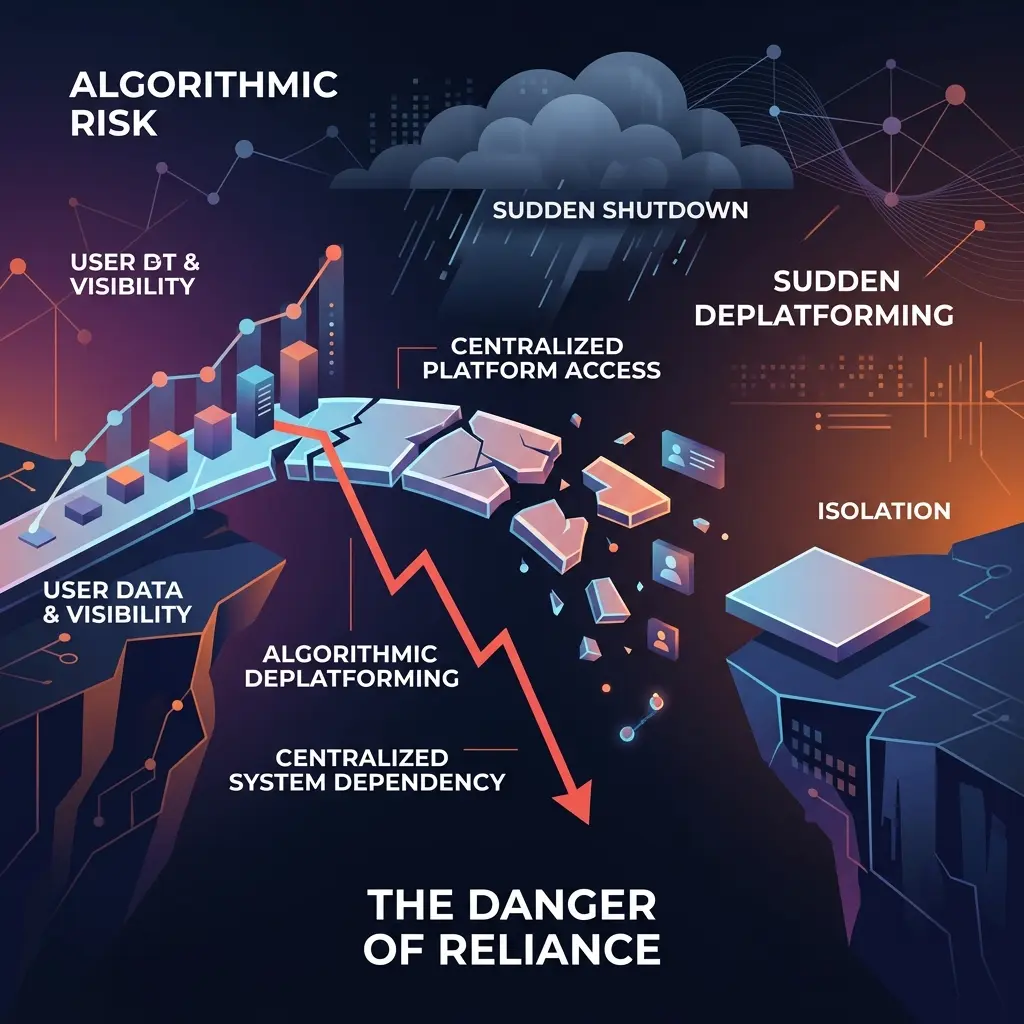
For the past decade, creators and businesses have built their digital empires on rented land. We optimized for Facebook, danced for TikTok, paid for verification badges on X, and chased view counts on Instagram. But as algorithms shift away from showing you updates from people you follow toward AI-generated recommendations and pay-to-play visibility models, a chilling reality has set in: you don't own your audience; the platforms do.
When only a fraction of your followers actually see your posts, what is a follower count actually worth?

The Organic Reach Decline
To understand the severity of platform dependency, let's review the historical decline of organic reach on traditional social media networks:
- 2012: Brands on Facebook enjoyed an average organic reach of 16% to their page followers.
- 2014: Facebook shifted its algorithm to prioritize paid advertising, dropping organic reach to 6%.
- 2018: Further algorithmic changes suppressed brand pages, dropping reach to 2% or less.
- Present Day: Across Instagram, Facebook, and LinkedIn, organic reach typically hovers between 1.2% and 2.5%. If you have 10,000 followers, fewer than 200 of them see your posts without you paying to "boost" them.
Centralized platforms have essentially constructed a tollbooth between you and your own audience. You did the work to attract the followers, but you must pay the platform to speak to them.
Enter the Open Web
The Open Web (specifically the federated social web via open protocols like ActivityPub, the AT Protocol, and Nostr) completely flips this model. Instead of a single corporate server controlling your identity and distribution, the network is decentralized and interoperable.
Here is what that means in practical terms for creators and businesses:
1. Uncapped Organic Reach
There is no middleman algorithm suppressing your content. When you post on a federated platform like Mastodon or a Nostr relay, 100% of your active followers receive your post in their timeline in reverse chronological order. If someone follows you, they see your updates. No filters, no tollbooths, and no algorithmic manipulation.
2. Permanent Identity & Data Portability
On the federated web, your digital identity is tied to your own domain name or a portable personal identifier. If you don't like the hosting policies, user interface, or terms of service of your current server, you can migrate your account—including all of your posts, content history, and followers—to a new server without losing a single connection.
This portability is powered by concepts like Personal Data Servers (PDS) in the AT Protocol. Your data sits on a server you control, while specialized indexers crawl that data to display it on social networks like Bluesky. Your audience belongs to you permanently.
3. SEO Equity and Indexability
Traditional social media networks are walled gardens. Your best posts on Instagram or X are hidden behind logins and are largely invisible to search engine indexers. Once they slide down the timeline, they disappear into a black box.
On the open web, your federated profile and posts are indexable and permanent. This allows you to build a true, long-lasting digital footprint. When a creator establishes their own domain and federated presence, they rank higher for their own brand name and niche keywords. This isn't just about traffic—it's about owning the search results when potential customers look you up, thereby cementing your brand identity as an authority.
Understanding Open Social Protocols: ActivityPub vs. AT Protocol vs. Nostr
When transitioning to the Open Web, creators often ask which protocol they should choose. The federated ecosystem offers three leading open standards, each tailored for different audience interaction styles:
- ActivityPub (W3C Standard): The engine powering Mastodon, Pixelfed, and PeerTube. ActivityPub utilizes server-to-server federation where independent instances exchange messages. It is ideal for community-focused creators who want rich media publishing and decentralized moderation.
- AT Protocol (Bluesky): Designed for high-scale, public conversation with strong data portability. Utilizing Personal Data Servers (PDS) and cryptographic DID signatures, AT Protocol allows users to seamlessly switch hosting providers without breaking follower links.
- Nostr: A lightweight, censorship-resistant relay network based on cryptographic keypairs. Content is signed with private keys and broadcast to distributed relays, eliminating server dependencies entirely.
By leveraging open standards rather than proprietary apps, creators ensure that their brand presence remains resilient regardless of platform shifts.
How to Get Started: The Hybrid Model
You don't need to abandon your current social strategy overnight. The best approach is a hybrid one:
- Claim Your Domain Identity: Setup a federated profile on Mastodon, Bluesky, or Nostr using a custom domain (e.g.
@username@yourdomain.com). This ensures that your social handle is directly tied to a domain asset you own. - Post Independently First: Host your content on your own website, and use open protocols to syndicate updates to your social followers automatically.
- Get Listed in Directories: Signal trust to search engine indexers by registering your federated profile in directories (like the Open Social Directory). Backlinks from established open web hubs verify your listing's authority.
The future of the internet isn't locked in a proprietary app. It is open, connected, and built on protocols, not platforms. Take back ownership of your audience today by listing your business on the Open Social Business Directory.
Sources and References
- W3C Recommendation: ActivityPub Protocol Standard
- AT Protocol Spec: Decentralized Social Data Portability
- HubSpot: Declining Organic Reach on Social Networks
Comments
Loading comments from the Open Web...